Air Canada's Bot Gave Wrong Information. The Tribunal Said That Was Air Canada's Problem.
In 2024, Air Canada argued that its chatbot was a separate legal entity and not the company's responsibility. A tribunal disagreed. Here is what every business owner should take from this.

In early 2024, a Canadian tribunal made a ruling that most business owners never heard about. They should have.
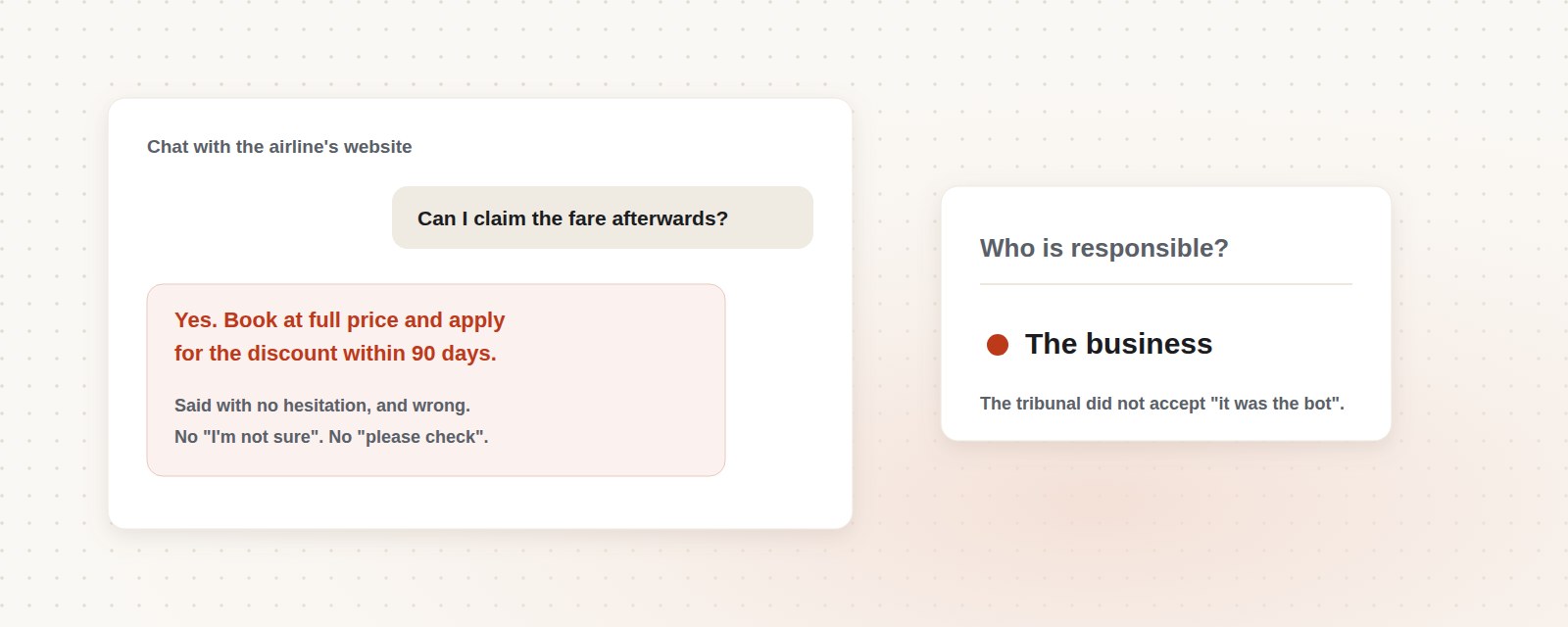
A passenger named Jake Moffatt lost a family member and needed to fly on short notice. He went to Air Canada's website and used the chatbot to ask about bereavement fares, which are reduced-price tickets available when a close relative dies. The chatbot told him he could buy the ticket at full price, travel, and apply for the bereavement discount afterwards, within 90 days of the date the ticket was issued.
That is not Air Canada's policy. Bereavement fares have to be applied at the time of booking.
He bought the ticket at full price. He traveled. He applied for the discount afterward, as the chatbot had told him to. Air Canada denied the claim, pointing to their actual policy.
He took it to the BC Civil Resolution Tribunal.
What Air Canada argued
Air Canada's legal defense was, to put it plainly, remarkable. The airline argued that its chatbot was a "separate legal entity", and that therefore Air Canada could not be held responsible for what the chatbot said.
The tribunal rejected this completely.
Tribunal member Christopher Rivers wrote: “While a chatbot has an interactive component, it is still just a part of Air Canada’s website. It should be obvious to Air Canada that it is responsible for all the information on its website. It makes no difference whether the information comes from a static page or a chatbot.”
Air Canada also argued that its correct policy was published elsewhere on the same website. The tribunal said it is not the customer’s job to work out which parts of a company’s website are accurate and which are not.
The ruling
Air Canada was ordered to pay Moffatt $812.02 CAD in damages and tribunal fees.
The amount was small. The principle was not.
What this means for your business
The ruling established something that sounds obvious in hindsight but that many businesses have not yet internalized: your AI agent speaks for you. When it tells a customer something, and that customer acts on it, you own the outcome.
"I didn't write that, the AI did" is not a defense. Air Canada's chatbot was on Air Canada's website, answering questions on Air Canada's behalf, and the tribunal treated what it said as the company's own.
If your AI agent tells a customer the wrong price, the wrong policy, the wrong deadline, and that customer relies on it, that is your problem.
The specific failure in this case
What made Air Canada's situation worse was not just that the chatbot got it wrong. It was that the chatbot got it wrong confidently. It did not say "I'm not sure about the retroactive policy. Let me point you to someone who can confirm." It gave a specific, actionable answer, with details. And the customer trusted it.
This is the most dangerous behavior an AI agent can have: confident wrong answers. A wrong answer delivered with hesitation and a suggestion to verify is recoverable. A wrong answer delivered with certainty is not.
The fix is not complicated
Before any AI agent represents your business to customers, it needs to know what to do when it does not know the answer. Not guess. Not extrapolate from similar situations. Say: "I don't have enough information to answer this accurately. Here's how to get a confirmed answer."
That is not a sign of a weak AI. It is a sign of a well-configured one.
Air Canada's chatbot did not know its bereavement fare policy well enough to answer the question correctly. The right behavior was to say so. Instead, it invented a policy and delivered it as fact.
The customer trusted a confident wrong answer. Air Canada paid for it.
Reported by CBS News, 19 February 2024.
This is the failure that setting the right rules before an agent runs is meant to prevent. Three related questions: what to settle before an agent touches your budget, how to choose the agent to build on, and how one coach kept the human part of his work and gave the agent the rest. If the cost is what you want to know first, here is what an agent costs next to a hire.
Want an agent you can trust to speak for your business? Let us build it.
Talk to us