Can an AI Agent Run My Ad Campaigns?
Paid advertising looks like the perfect job to hand an agent. Some of it is. Here is what to settle before you give one access to your budget.

Paid advertising is one of the most tempting places to bring in an agent. The work is repetitive, data driven, and time consuming. You are writing copy, adjusting bids, creating variations, pausing underperformers, and reporting results. All of it sounds like exactly what a well built agent should handle.
Some of it is. But there are a few things worth understanding before you hand over the keys.
The work you hand off should be work you already know
The right place to start with an agent is the part of your business you understand best. When you know the work, you can supervise it. You can give the agent real feedback, catch the gaps, and improve it over time. You are reducing your load while staying close enough to notice when something is off.
Paid advertising requires that same supervision, and then some. If you do not understand match types, bid strategies, or what a good cost per lead looks like for your business, the agent cannot fix that. It can execute. It cannot set direction. And if you are not close enough to the work to know when something looks wrong, you are not the right person to be supervising it.
If you do not know paid advertising yet, start somewhere else. Give the agent the work that frees up your time. Use that time to learn. Once you understand enough to ask the right questions and recognize when something looks wrong, you are ready to bring in an agent for the harder stuff.
An agent with budget access has a fast path to expensive mistakes
This is not a reason to avoid it. It is a reason to be deliberate about it.
An agent with the ability to create campaigns and spend budget carries real financial risk. A misunderstood instruction, a bad parameter, a small bug, and you can burn through significant spend before you notice.
Start with read only. Build an agent that reads your data and reports on it before you give it the ability to act. Let it tell you what is working before you let it decide what to do.
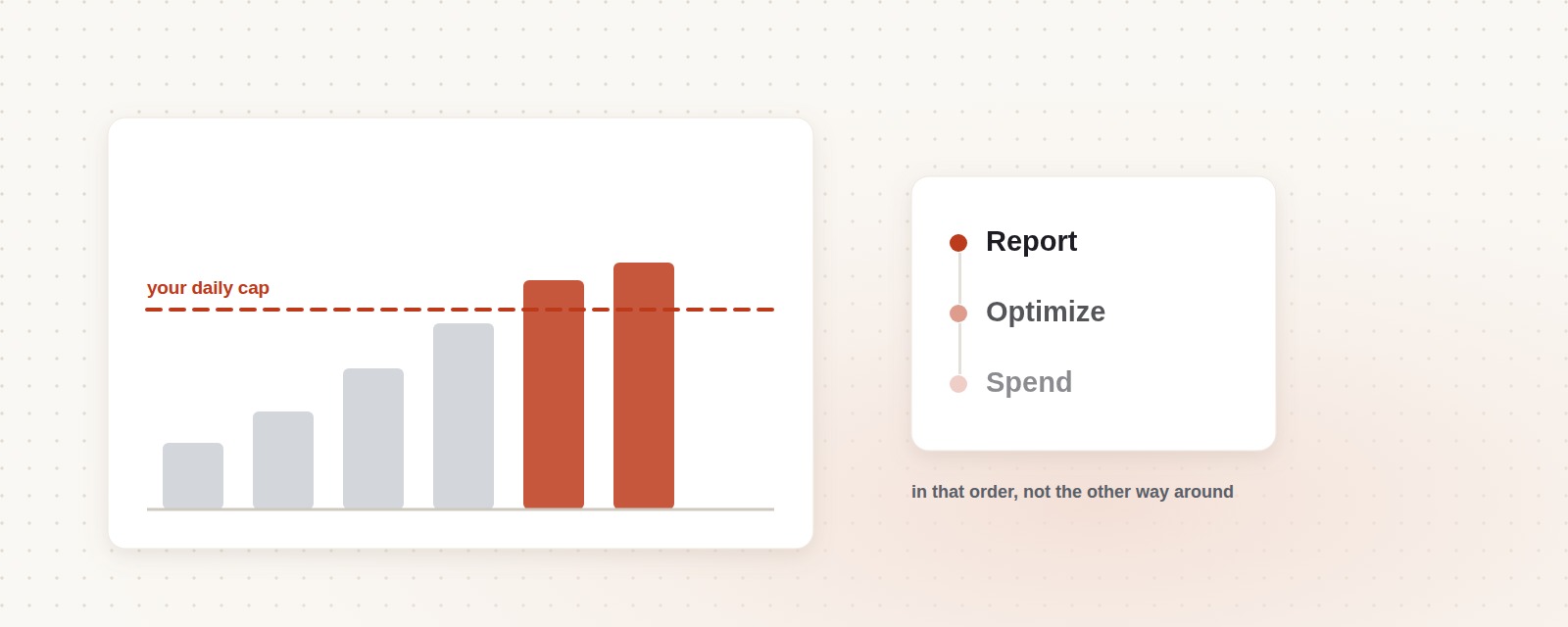
Report before you optimize. Optimize before you spend.
The agent doesn’t feel the pain of the bill. You do.
It will surface data. It will make recommendations. But paid advertising is not an exact science, and there is a meaningful difference between an agent executing a strategy and a person thinking carefully about whether that strategy is right.
The problem is that if you do not understand paid advertising well enough, you will not know what questions to ask. You will not know when the numbers look off. You will not know whether the strategy is working or just spending.
This is exactly why you start with the work you already know. An agent handling your follow ups or your scheduling frees up real time. Time you can use to get closer to the parts of your business you do not yet understand well, like paid advertising. You learn it. Then you bring in the agent.
In that order, not the other way around.
A spending cap is not paranoia
If you build an agent with spending capabilities, hard limits are not a nice to have. Set a maximum daily spend. Set a maximum per campaign. Set an alert that pauses everything and notifies you before it crosses a line you would regret.
The agent should never be the last line of defense. You are.
The platform updates. The agent doesn’t.
Meta, Google, and LinkedIn update their policies, interfaces, and APIs regularly. An agent built for the platform today may behave unexpectedly after an update. Build in a human review step for anything that touches platform level settings, and stay close enough to your campaigns that you notice when something looks off.
The work you already know is the place to start. Here is what that looked like for one coach, and how to choose the agent to build it on.
Not sure which work to hand over first?
Tell me what’s eating your time